Why Middle Tennessee's Clay Soil Causes Driveways to Crack and Heave
QUICK ANSWER: Clay-heavy soil around Springfield and greater Robertson County swells when it absorbs rainfall and shrinks as it dries, and that repeated movement pushes and pulls on whatever sits above it, including a concrete driveway. A slab poured over uncompacted or unstable clay has nothing solid to rest on, so it lifts, settles unevenly, or cracks outside its control joints as the ground beneath it shifts through the seasons. Correcting the grade, compacting a proper gravel base, and directing water away from the slab before the pour are what keep a driveway flat. Once cracking or heaving has already set in, the fix is rarely cosmetic — it usually means addressing the base underneath, not just the surface on top.
If your driveway looked flat the day it was poured but now has a rise near the garage apron, or a crack running corner to corner instead of tracking the control joints, you're not imagining things. Homeowners across Springfield, Coopertown, and the rest of Robertson County see this pattern often enough that it's rarely bad luck. It's what's under the concrete. Middle Tennessee sits on clay-heavy soil, and clay doesn't stay still. It swells when it's wet and shrinks when it dries, and a driveway poured without planning for that movement starts fighting the ground beneath it from day one.
What Makes Clay Soil Different Underneath a Driveway
Clay particles are small and flat, packed tight enough that water struggles to pass through them. Sand or gravel would let water drain right along; clay holds onto it and swells as it absorbs more. The Colorado Geological Survey traces this expansion to a chemical attraction between water molecules and certain clay minerals, and that same swell-and-shrink cycle shows up anywhere clay-heavy soil is common — including the silty, clay-rich ground you'll find across much of Middle Tennessee. Then a hot, dry stretch hits. The soil contracts again, and whatever it was supporting drops with it.
Concrete has no give. It's rigid by design. So when the ground beneath a slab swells unevenly, the slab either rides along with the soil or resists it and cracks under the strain. Neither outcome ends well, and both get worse the longer the cycle repeats.
The Chain Reaction from Soil Movement to Slab Damage
Cracking and heaving rarely trace back to one single event. It's a chain reaction, playing out over several wet-dry cycles before you ever notice it.
Uneven support develops first. Clay swells and shrinks at different rates across a driveway's footprint — more moisture near a downspout, less under a section shaded from rain — so the soil stops supporting the slab uniformly. One section stays firm while another lifts or settles.
From there, the slab starts bridging the gap. Concrete handles compression well but hates tension, the stress created when something bends. A slab spanning a soft or lifted section behaves like a beam stretched over a gap, and bending under its own weight is exactly what a driveway slab was never built to do.
Once the slab is under enough of that stress, it cracks — and where it cracks depends on the prep work. Cut control joints in the right places, and the crack usually follows one of them and stays manageable. Get the joint spacing or subgrade wrong, and the crack runs wherever the stress is highest, cutting across the slab instead of along a planned line.
Heaving tends to show up last, and it shows up at edges and low points. Areas near the garage apron, along the street connection, or wherever water collects are usually the first to develop a noticeable rise, since those spots take the most repeated wetting and drying.
Compaction and Base Prep Are the First Line of Defense
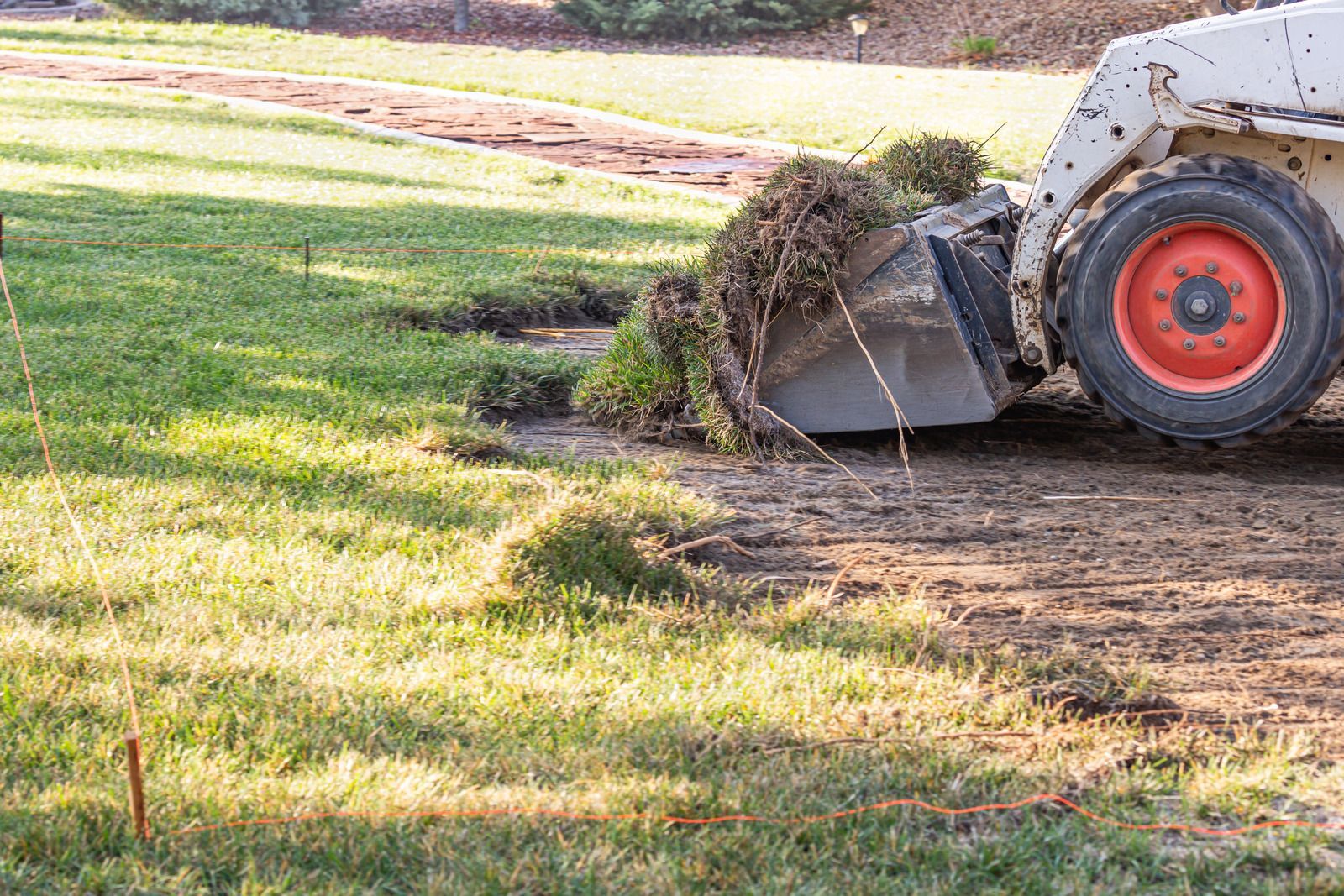
Most of what prevents this cycle happens before the concrete truck ever shows up. A well-compacted gravel base does more than support the weight of the slab — it also acts as a buffer between the clay subgrade and the concrete above it, spreading the load evenly and reducing how much the clay's movement transfers upward. Industry guidance from the American Concrete Institute treats the subgrade, subbase, and base course as three distinct layers, each compacted and graded before the next goes down, because uniform support underneath is what keeps a slab from bending unevenly on top. Skipping or shortcutting that compaction step is one of the most common reasons a driveway fails years ahead of schedule, regardless of how well the concrete itself was finished.
Grading also plays a direct role. Water that's allowed to pool near the edge of a driveway or run underneath it instead of away from it keeps the clay beneath that section wetter than the rest of the slab, feeding the same uneven swelling that leads to cracks. Shaping the ground to carry water off to the side before the base goes in is as important to a driveway's long-term flatness as the pour itself.
Control Joints and Reinforcement Manage the Movement You Can't Eliminate
No amount of base prep eliminates soil movement entirely, so the rest of the job is about managing where that movement shows up. Control joints are cut at planned intervals to give the slab a weak point where it can crack in a straight, hidden line instead of at random. Wire mesh or rebar, sized to the slab's thickness, doesn't stop cracking, but it holds the two sides of a crack tight together once one forms, which keeps water and debris from working their way in and widening the gap over time.
TIP: Watch drainage patterns for a full season before assuming a crack is cosmetic. A hairline crack that widens after a wet spring points to ongoing soil movement underneath, not just surface wear.
Signs the Soil Underneath Is Already Moving
Walk your driveway after the next hard rain and look for a few specific patterns.
A hump near the garage or the street is the most obvious one — a noticeable rise where the driveway meets a fixed structure, which usually means the soil under that section has swollen more than the rest of the slab. Cracks matter too, but not all cracks are equal. Straight ones tracking the joint pattern are expected and not much to worry about. Diagonal or branching cracks are a different story; they suggest the slab was under stress the joints weren't positioned to catch.
Then there are the gaps. A widening seam between the driveway and the garage apron or sidewalk points to differential settlement, meaning one section is moving independently of the other. And standing water after rain is both a symptom and a cause — a sign your original grading fell short, and a reason the clay underneath stays saturated longer than the rest of the yard.
WARNING: A driveway that has heaved more than an inch or developed multiple wide, connected cracks usually points to a base problem, not a surface one. Patching the concrete without correcting what's underneath typically means repeating the repair within a few years.
Frequently Asked Questions
Does every driveway in Middle Tennessee have this problem?
No. Clay soil is common across Middle Tennessee, but proper grading, drainage, and base compaction reduce movement. Driveways lacking these preparation steps face greater risks of cracking and heaving.
Can a cracked driveway be repaired without replacing it?
Yes, depending on the cause. Small shrinkage cracks can often be sealed or patched, while cracks caused by soil movement usually require correcting the underlying base to prevent recurring damage.
How can I tell if a crack is from soil movement or just normal shrinkage?
Shrinkage cracks are typically thin, straight, and stable over time. Soil movement cracks may widen seasonally, cross control joints diagonally, or appear alongside noticeable dips, raised sections, or uneven concrete surfaces.
Does adding rebar or wire mesh stop clay soil from moving?
No. Rebar and wire mesh reinforce concrete but cannot stop clay soil movement. They help hold cracked sections together, while proper grading, drainage, and base compaction address underlying soil movement.
Is regrading the yard enough to protect a driveway from clay soil movement?
Regrading helps direct water away from the driveway, reducing clay saturation and movement. However, lasting protection also requires a properly compacted base that provides consistent support beneath the concrete slab.
Building Driveways That Stand Up to Clay Soil
Clay soil will keep swelling and shrinking through Middle Tennessee’s wet springs and dry summers, so lasting driveway performance starts below the concrete. Proper grading, consistent compaction, a stable gravel base, and controlled drainage help reduce uneven movement and give the slab dependable support. In Springfield, TN, these preparation steps are especially important because moisture changes can quickly affect clay-heavy ground. Careful groundwork allows the driveway to handle seasonal conditions without developing premature cracks, settlement, or noticeable heaving over time.
With 30
years of experience, Cope Brothers Inc
understands how local soil conditions influence
concrete driveways
from the ground up. A well-built driveway is not simply about achieving a smooth finish on pour day; it depends on preparing the site for years of changing moisture levels underneath. When the base is properly compacted and water is directed away from the slab, concrete has a stronger, more uniform foundation, helping it remain level, stable, and dependable through changing seasons.
Recent Posts